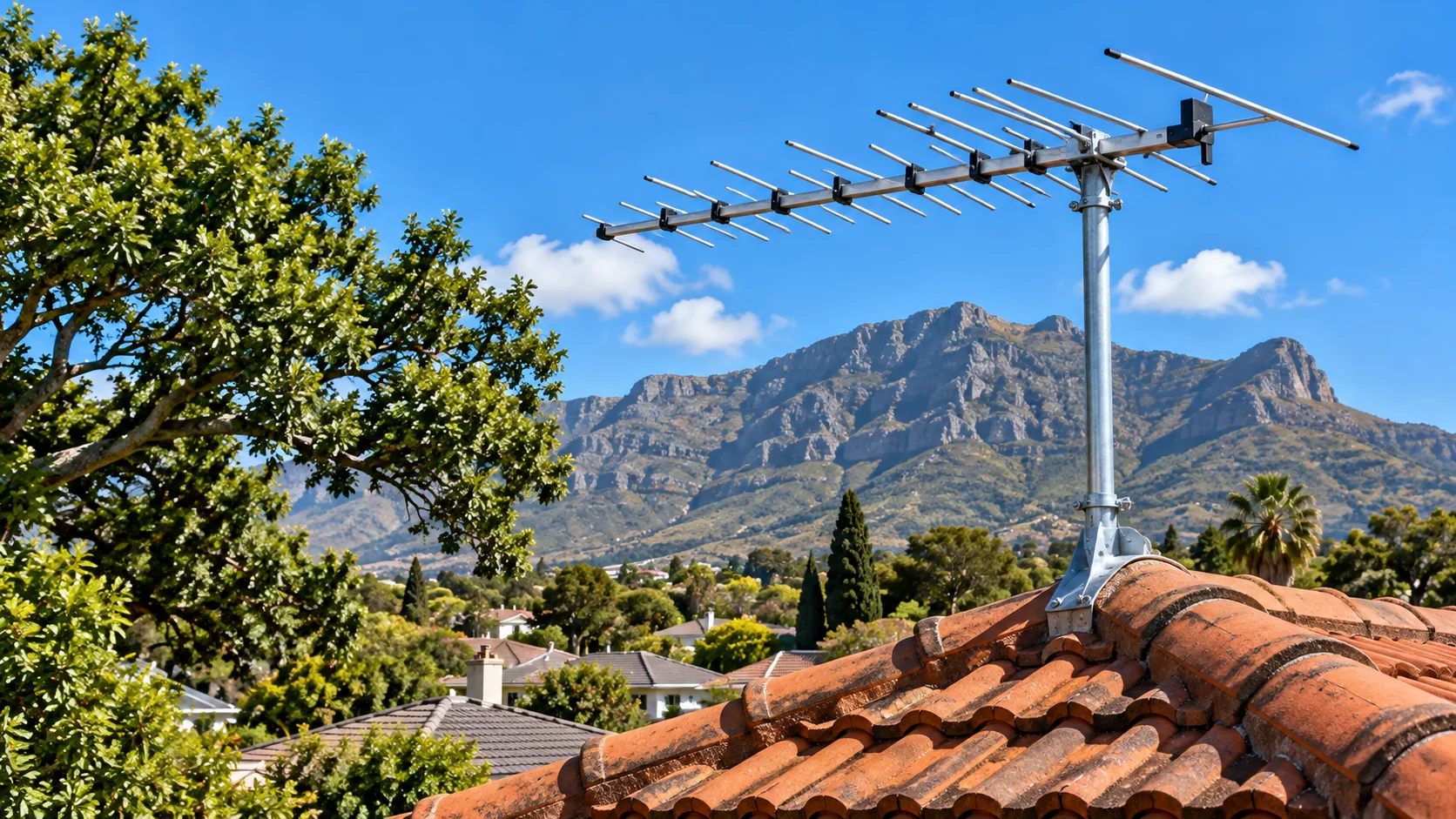
A terrestrial aerial picks up the free to air channels without a dish and without a subscription. It sounds simple, and on a good site it is, but reception depends heavily on where the house sits and what is between the aerial and the transmitter. We check the signal on site, pick the mounting position and height that works, and scan the channels in.
Rondebosch sits on the mountain side of the southern suburbs, which means terrestrial reception varies street by street. Some properties get a clean signal from a modest aerial in the roof space. Others are in the shadow of the slope or screened by mature oaks and neighbouring double storey homes, and need a proper external aerial at height.
- Reception tested on site before the aerial is chosen
- Aerial mounted into solid brick or on a braced mast
- Aimed on a meter for signal quality, not just strength
- Coax run with a drip loop and sealed wall penetration
- All available channels scanned in and tested with you
How we do it
TV Aerial Installation in Rondebosch, done properly
Reception in a mountain side suburb
Terrestrial signal does not bend around a hillside the way people hope. Properties lower down or tucked behind the slope can sit in a weak patch while a house up the road is fine, so we measure rather than assume. Where the level is marginal, extra height on the mast or a higher gain aerial often makes the difference, and occasionally an amplifier is the honest answer.
Trees, height and the mast
The mature oaks and planes that shade so much of Rondebosch affect terrestrial signal as well as satellite. Wet foliage in a Cape winter storm and a full canopy in spring both cut the level. If the only clear path is above the trees we fit a braced mast rather than accepting a signal that works some months and not others. Brackets go into solid brick, never into fascia board.
Multiple rooms and existing cabling
One aerial can feed several televisions through a distribution amplifier, which keeps the level up instead of halving it at a splitter. In the older houses here we often find aerial cable that was run decades ago, sometimes stapled through its own shield. We test the existing runs, reuse what is sound, and replace what is losing signal rather than adding an amplifier to hide the loss.
Common questions
TV Aerial Installation in Rondebosch: your questions answered
Do I need an aerial if I have a dish?
Not usually, because satellite carries the same free to air channels. An aerial is worth having if you want terrestrial channels on a second television without another decoder, or as a backup that keeps working when heavy rain briefly affects the satellite picture. We will tell you which makes sense for your setup.
Can the aerial go in the roof space?
Sometimes, where the signal level is strong enough to survive the roof covering, and it does keep the hardware out of the weather. In the weaker patches around the mountain side of Rondebosch a loft aerial simply will not hold the channels, and it has to go outside at height. The reading on site decides it.
Why do I lose channels when it rains?
Terrestrial reception drops when the level is marginal to begin with, and wet trees and storm conditions push it below what the tuner needs. The fix is more signal rather than more amplification, so we look at aerial height, aerial type and the state of the cable before adding anything electronic.
Can you replace an old aerial and reuse the cable?
Often yes. We test the existing coax for loss and for damage first. If it reads well, we fit the new aerial to the existing run and save you the disruption. If the cable is chafed, corroded at the connector or stapled through the shield, replacing it is the only way to see the benefit.
Related services
Other DSTV work we do in Rondebosch
Ready to book
Book TV aerial installation in Rondebosch
We work Monday to Saturday across Rondebosch and the suburbs around it, with emergency callouts when a business is down.